
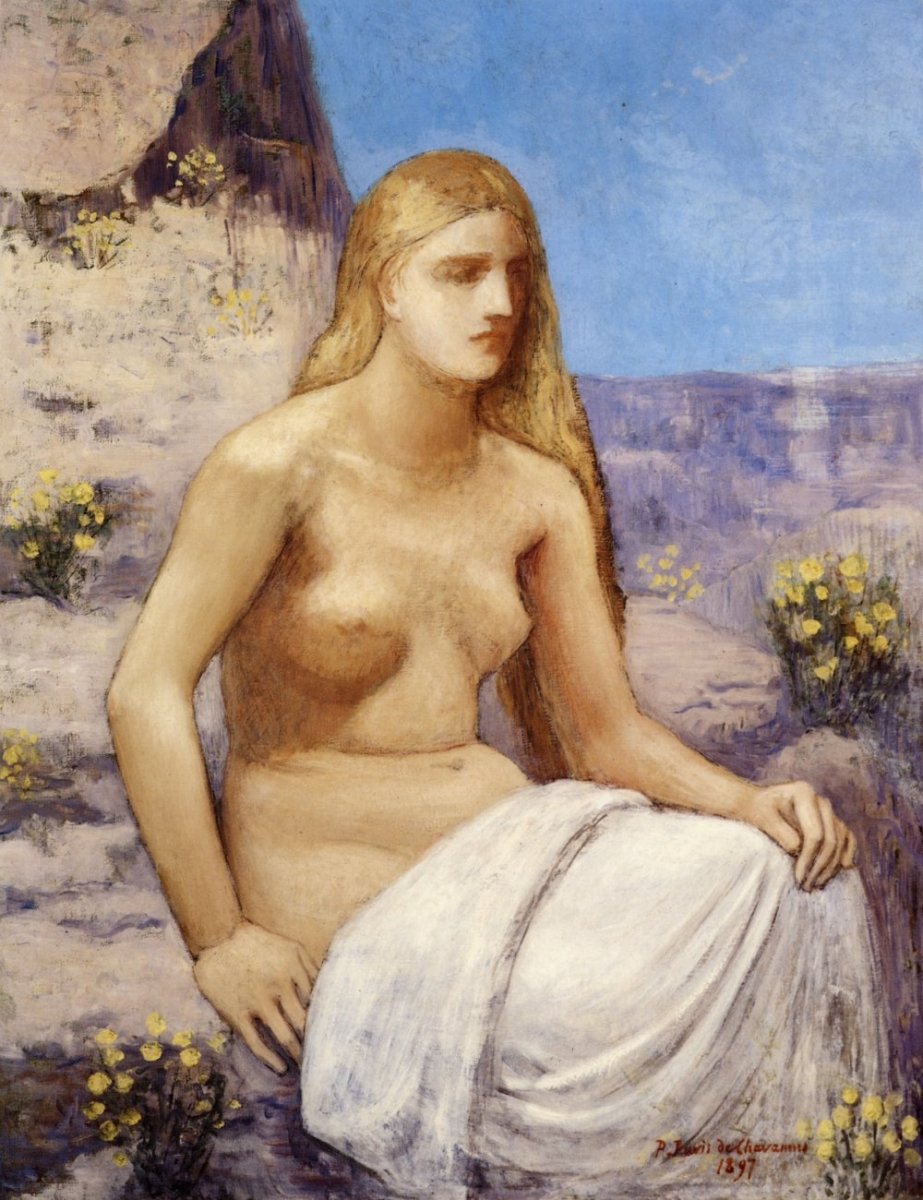
Pierre Puvis de Chavannes (1824-1898) was a French painter known for his mural painting, who came to be known as "the painter for France". He became the co-founder and president of the Société Nationale des Beaux-Arts, and his work influenced many other artists, notably Robert Genin, and he aided medallists by designs and suggestions for their works. Puvis de Chavannes was a prominent painter in the early Third Republic. Émile Zola described his work as "an art made of reason, passion, and will".
Puvis de Chavannes was born Pierre-Cécile Puvis in a suburb of Lyon, France, on December 14, 1824. He was the son of a mining engineer and descended from an old noble family of Burgundy. He later added the ancestral "de Chavannes" to his name. Throughout his life, he spurned his Lyon origins, preferring to identify himself with the 'strong' blood of the Burgundians, where his father originated.
Puvis de Chavannes was educated at the Amiens College and at the Lycée Henri IV in Paris. He intended to follow his father's profession until a serious illness compelled him to convalesce at Mâcon with his brother and sister-in-law in 1844 and 1845, which interrupted his studies. A journey to Italy opened his mind to fresh ideas, and on his return to Paris in 1846, he announced his intention to become a painter.
He studied first under Eugène Delacroix, but only very briefly, as Delacroix closed his studio shortly afterwards due to ill health. He studied subsequently under Henri Scheffer and then Thomas Couture. His training was not classical as he found that he preferred to work alone. He took a large studio near the Gare de Lyon and attended anatomy classes at the Académie des Beaux Arts. It was not until a number of years later, when the government of France acquired one of his works, that he gained wide recognition.
In 1850, Puvis de Chavannes made his Salon debut with Dead Christ, Jeune noir à l'épée (Black youth with a sword), The Reading Lesson, and Portrait of a Man.
Puvis de Chavannes's work is seen as symbolist in nature, even though he studied with some of the romanticists, and he is credited with influencing an entire generation of painters and sculptors, particularly the works of the Modernists. One of his protégés was Georges de Feure.
Puvis de Chavannes is best known for his mural painting, and came to be known as 'the painter for France.' His first commission was for his brother's chateau, Le Brouchy, a medieval-style structure near Cuiseaux in Saône-et-Loire. The principal decorations take the four seasons as their theme. His first public commissions came early in the 1860s, with work at the Musée de Picardie at Amiens. The first four works were Concordia (1861), Bellum (1861), Le Travail (Work; 1863) and Le Repos (Rest; 1863). Between 1883 and 1886 he painted a mural for the Museum of Fine Arts in Lyon.
Over the course of his career, Puvis received a substantial number of commissions for works to be carried out in public and private institutions throughout France. His early work at the Musée de Picardie had helped him to develop his classicising style, and the decorative aesthetic of his mural works.
As far as the appreciation of his life's work is concerned, Puvis de Chavannes was never properly understood by his contemporaries. At the beginning of his career, art criticism was divided into two camps. Adored by the idealists, he was despised by the partisans of the realists. Only with the advent of Symbolism did these two camps unite, but without achieving a convincing appreciation of the painter. Today's research has inherited this contradiction of art criticism and therefore still does not offer a convincing presentation of Puvis de Chavanne's art.
In Montmartre, he had an affair with one of his models, Suzanne Valadon, who would become one of the leading artists of the day as well as the mother, teacher, and mentor of Maurice Utrillo. From 1856, he was in a relationship with the Romanian princess, Marie Cantacuzène. The couple were together for 40 years, and were married before their deaths in 1898.
Images to download
-

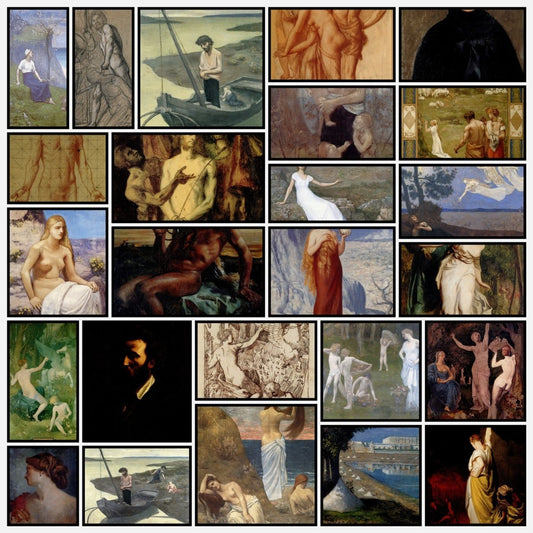
Pierre Puvis de Chavannes 25 High Resolution Images
Vendor:Digital Download - 25 imagesRegular price £3.00Regular priceUnit price per -

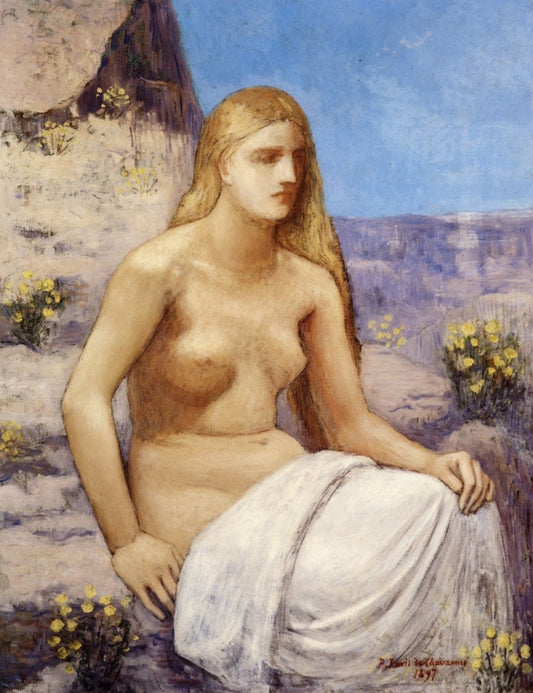
Chavannes, Pierre Puvis de (1824-1898) - Mary Magdalene 1897
Vendor:Digital Download - 1 imageRegular price £0.80Regular priceUnit price per -

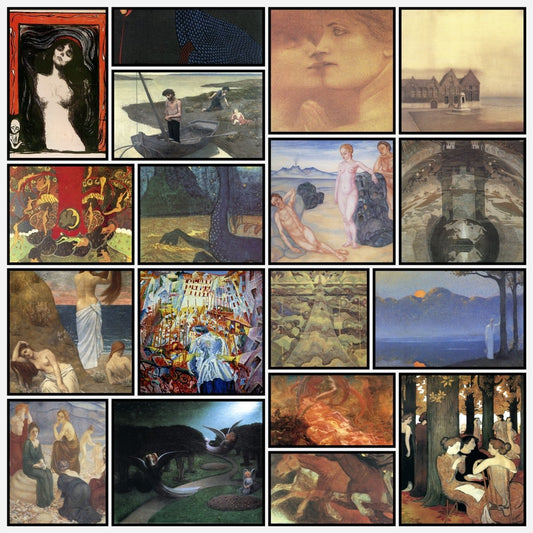
Symbolism Collection - 65 High Resolution Images
Vendor:Digital Download - 65 imagesRegular price £4.00Regular priceUnit price per


Latest Picture Trove Blog Posts
View all-

William Morris’s Strawberry Thief: The Story Behind a Classic Arts and Crafts Pattern
Few William Morris designs are as instantly recognisable as Strawberry Thief. With its richly patterned foliage, small red strawberries and watchful birds hidden among curling leaves, it has become one of the most loved designs of the Arts and Crafts movement.
William Morris’s Strawberry Thief: The Story Behind a Classic Arts and Crafts Pattern
Few William Morris designs are as instantly recognisable as Strawberry Thief. With its richly patterned foliage, small red strawberries and watchful birds hidden among curling leaves, it has become one of the most loved designs of the Arts and Crafts movement.
-

Glasgow and the Mackintosh Style
We recently took ourselves off to Scotland, and on our travels, we popped into the Mackintosh Tea Rooms in Glasgow for a bit of a nose around and a spot of lunch.
Glasgow and the Mackintosh Style
We recently took ourselves off to Scotland, and on our travels, we popped into the Mackintosh Tea Rooms in Glasgow for a bit of a nose around and a spot of lunch.
-

A Trip to Edinburgh & Glasgow, and Scottish Art
We have just returned from a well-deserved few days' break in Scotland, visiting both Edinburgh and Glasgow, taking in Scottish art and tea rooms!
A Trip to Edinburgh & Glasgow, and Scottish Art
We have just returned from a well-deserved few days' break in Scotland, visiting both Edinburgh and Glasgow, taking in Scottish art and tea rooms!


