

Karl Pavlovich Bryullov(a) (Карл Па́влович Брюлло́в) (1799-1852) was a Russian painter and draughtsman during the Romantic period, remembered among the greatest visual artists in the history of Russian art.
Bryullov was born in December 1799 in St. Petersburg, in the family of the academician, woodcarver, and engraver Pavel Ivanovich Briullo (1760-1833), who was of Huguenot descent. He felt drawn to Italy from his early years. Despite his education at the Imperial Academy of Arts (1809-1821), Bryullov never fully embraced the classical style taught by his mentors and promoted by his brother, Alexander Bryullov. After distinguishing himself as a promising and imaginative student and completing his education, he left Russia for Rome, where he worked as a portraitist and genre painter until 1835. However, it was not until he began creating historical paintings that his fame as an artist truly took hold.
His best-known work, The Last Day of Pompeii (1830-1833), is a vast composition compared by Pushkin and Gogol to the best works of Rubens and Van Dyck. It created a sensation in Italy and established Bryullov as one of the finest European painters of his day. After completing this work, he triumphantly returned to the Russian capital, where he made many friends among the aristocracy and intellectual elite and obtained a high post in the Imperial Academy of Arts.
While teaching at the academy (1836-1848), he developed a portrait style that combined neoclassical simplicity with a romantic tendency, which fused well, and his penchant for realism was satisfied with an intriguing level of psychological penetration. While he was working on the plafond of St Isaac's Cathedral, his health suddenly deteriorated. Following the advice of his doctors, Bryullov left Russia for Madeira in 1849 and spent the last three years of his life in Italy. He died in the village of Manziana near Rome and is buried at the Cimitero Acattolico there.
Images to download
-

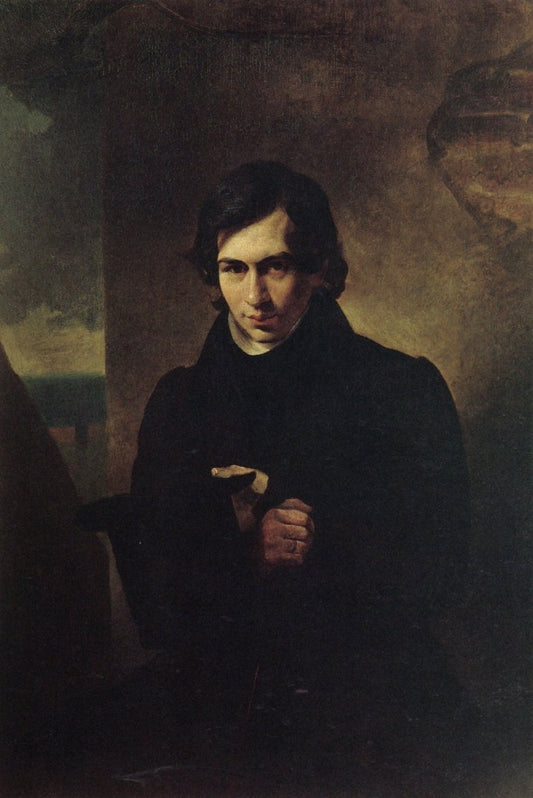
Bryullov, Karl (1799-1852) - Portrait of Nikolai Kukolnik 1836
Vendor:Digital Download - 1 imageRegular price £0.80Regular priceUnit price per

Latest Picture Trove Blog Posts
View all-

William Morris’s Strawberry Thief: The Story Behind a Classic Arts and Crafts Pattern
Few William Morris designs are as instantly recognisable as Strawberry Thief. With its richly patterned foliage, small red strawberries and watchful birds hidden among curling leaves, it has become one of the most loved designs of the Arts and Crafts movement.
William Morris’s Strawberry Thief: The Story Behind a Classic Arts and Crafts Pattern
Few William Morris designs are as instantly recognisable as Strawberry Thief. With its richly patterned foliage, small red strawberries and watchful birds hidden among curling leaves, it has become one of the most loved designs of the Arts and Crafts movement.
-

Glasgow and the Mackintosh Style
We recently took ourselves off to Scotland, and on our travels, we popped into the Mackintosh Tea Rooms in Glasgow for a bit of a nose around and a spot of lunch.
Glasgow and the Mackintosh Style
We recently took ourselves off to Scotland, and on our travels, we popped into the Mackintosh Tea Rooms in Glasgow for a bit of a nose around and a spot of lunch.
-

A Trip to Edinburgh & Glasgow, and Scottish Art
We have just returned from a well-deserved few days' break in Scotland, visiting both Edinburgh and Glasgow, taking in Scottish art and tea rooms!
A Trip to Edinburgh & Glasgow, and Scottish Art
We have just returned from a well-deserved few days' break in Scotland, visiting both Edinburgh and Glasgow, taking in Scottish art and tea rooms!


