

Jan Bruegel the Younger (1601-1678) was a distinguished Flemish painter, renowned for his intricate landscapes, allegorical scenes, and floral still lifes. Born in Antwerp, Jan was the son of Jan Bruegel the Elder and the grandson of Pieter Bruegel the Elder, both illustrious figures in the history of art. Raised in a family steeped in artistic tradition, Jan was tutored by his father, inheriting a meticulous style and a keen eye for detail that would become hallmarks of his own work.
Following his father’s death in 1625, Jan Bruegel the Younger took over the family workshop, continuing and expanding its legacy. He was adept at replicating his father’s style so closely that works from the two are sometimes difficult to distinguish. However, Jan the Younger was not merely an imitator; he brought his own creative flair to his paintings, infusing them with a lighter palette and a more animated approach to composition.
Bruegel’s oeuvre spans a wide range of subjects. He is perhaps best known for his lush and vibrant landscapes, often populated with mythological or biblical figures. These works demonstrate his mastery of perspective and his ability to render nature with astonishing precision. His scenes frequently capture the idyllic countryside surrounding Antwerp, with meticulously depicted flora and fauna contributing to the paintings’ realism and charm.
In addition to landscapes, Jan Bruegel the Younger was a prolific painter of still lifes, particularly flower pieces. These compositions were highly prized by collectors of the time. His bouquets, often arranged in ornate vases, burst with an astonishing variety of blooms, rendered with scientific accuracy. The flowers - roses, tulips, irises, and more - are painted in vivid colours, their delicate petals and leaves carefully observed. Such works also carried symbolic meanings, reflecting the transience of life and the beauty of nature.
Collaboration was a significant aspect of Bruegel’s career. Like many artists of his era, he often worked alongside other painters, each contributing their specialisation to a single work. Bruegel would typically paint the landscapes or floral elements, while collaborators such as Peter Paul Rubens or Hendrick van Balen would add figures. These joint efforts produced some of the most celebrated paintings of the seventeenth century, blending the distinctive strengths of several masters.
Jan Bruegel the Younger’s career unfolded during a period of great turbulence in the Southern Netherlands, marked by war and political upheaval. Despite these challenges, he enjoyed considerable success, receiving commissions from both local and international patrons. He was appointed dean of the Antwerp Guild of Saint Luke, reflecting his standing in the artistic community.
Today, Bruegel’s paintings are held in major museums and collections worldwide, appreciated for their technical excellence and evocative beauty. His ability to capture the intricacies of the natural world, coupled with his contribution to the development of Flemish Baroque painting, secures his reputation as one of the leading artists of his generation.
Images to download
-

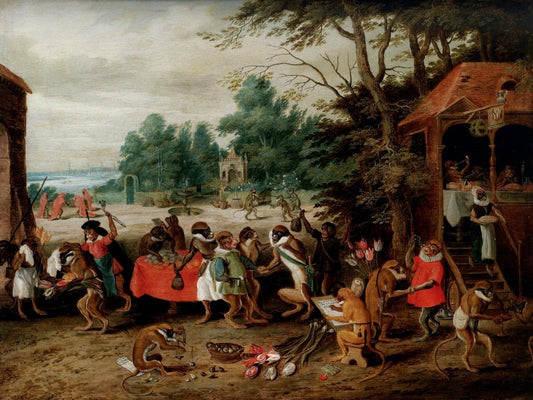
Bruegel the Younger, Jan (1601-1678) - A Satire on the Folly of Tulip Mania c.1640
Vendor:Digital Download - 2 imagesRegular price £0.80Regular priceUnit price per -

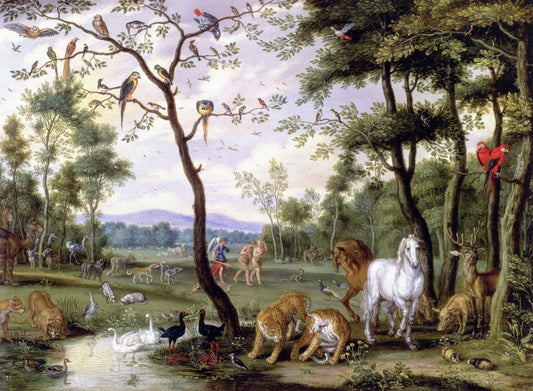
Bruegel the Younger, Jan (1601-1678) - Earthly Paradise
Vendor:Digital Download - 1 imageRegular price £0.80Regular priceUnit price per


Latest Picture Trove Blog Posts
View all-

William Morris’s Strawberry Thief: The Story Behind a Classic Arts and Crafts Pattern
Few William Morris designs are as instantly recognisable as Strawberry Thief. With its richly patterned foliage, small red strawberries and watchful birds hidden among curling leaves, it has become one of the most loved designs of the Arts and Crafts movement.
William Morris’s Strawberry Thief: The Story Behind a Classic Arts and Crafts Pattern
Few William Morris designs are as instantly recognisable as Strawberry Thief. With its richly patterned foliage, small red strawberries and watchful birds hidden among curling leaves, it has become one of the most loved designs of the Arts and Crafts movement.
-

Glasgow and the Mackintosh Style
We recently took ourselves off to Scotland, and on our travels, we popped into the Mackintosh Tea Rooms in Glasgow for a bit of a nose around and a spot of lunch.
Glasgow and the Mackintosh Style
We recently took ourselves off to Scotland, and on our travels, we popped into the Mackintosh Tea Rooms in Glasgow for a bit of a nose around and a spot of lunch.
-

A Trip to Edinburgh & Glasgow, and Scottish Art
We have just returned from a well-deserved few days' break in Scotland, visiting both Edinburgh and Glasgow, taking in Scottish art and tea rooms!
A Trip to Edinburgh & Glasgow, and Scottish Art
We have just returned from a well-deserved few days' break in Scotland, visiting both Edinburgh and Glasgow, taking in Scottish art and tea rooms!


