Adriaen Brouwer

Adriaen Brouwer
Adriaen Brouwer (c.1606-1638), a prominent figure in the artistic landscape of seventeenth-century Flanders, is celebrated for his evocative genre scenes and his masterful handling of light, colour, and expression. Born around 1605 or 1606 in Oudenaarde, in the Southern Netherlands (present-day Belgium), Brouwer’s career, though tragically brief, left an indelible mark on the evolution of genre painting and had a profound influence on his contemporaries and successors.

Brouwer’s early life remains somewhat shrouded in mystery due to scant historical records. What is certain is that, as a young man, he moved to Antwerp, then one of the leading artistic centres in Europe. There, he became acquainted with the works of such luminaries as Peter Paul Rubens and Anthony van Dyck, whose influence can be detected in various elements of his own paintings. Brouwer was probably a pupil of Frans Hals in Haarlem, a connection that would explain his remarkable skill in capturing fleeting expressions and lively brushwork reminiscent of the Dutch master.

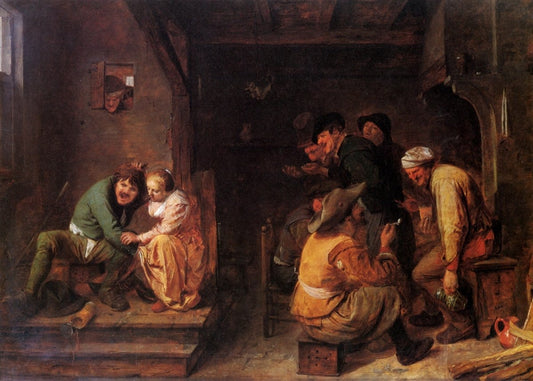
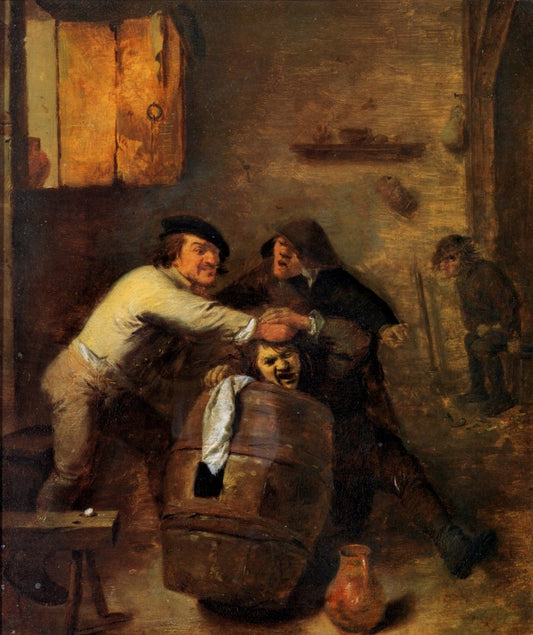
Brouwer’s oeuvre is dominated by genre scenes, especially those depicting tavern interiors, card players, musicians, peasants, and soldiers engaged in raucous merrymaking, quarrels, or moments of quiet introspection. Unlike many of his predecessors, who often depicted rural folk with a sense of moralising detachment, Brouwer’s approach was far more intimate and empathetic. His figures are rendered with a keen eye for human psychology, their faces contorted in laughter, pain, or anger, revealing the rawness of human emotion. His paintings, such as “The Bitter Draught” and “The Smokers”, exemplify this focus on expressive portraiture within everyday settings.

Brouwer’s technique was highly innovative for his time. He favoured a loose, spontaneous brushstroke that imbued his works with a sense of immediacy and vitality. His palette was often subdued, relying on subtle gradations of earth tones punctuated by occasional bursts of colour. The small scale of most of his paintings allowed him to concentrate on the minutiae of gesture and expression, while his deft handling of light and shadow contributed to the atmospheric quality of his scenes. In this, Brouwer anticipated later developments in genre painting and can be seen as a forerunner to the likes of Jean-Baptiste-Siméon Chardin in France and Thomas Gainsborough in England, both of whom would similarly fuse realism with a deep human sympathy.

Despite the earthy subject matter of his works, Brouwer was held in high esteem by his contemporaries, including Rubens, who owned several of his paintings. His depictions of the lower classes were not mere caricatures but nuanced studies of humanity, which resonated with a wide audience. Brouwer’s work also had a significant impact on the so-called “Bamboccianti”—a group of Dutch and Flemish genre painters active in Rome—and on subsequent generations of Flemish and Dutch artists, such as David Teniers the Younger and Jan Steen.

Tragically, Brouwer’s life was cut short in 1638, when he died in Antwerp at the age of about thirty-three. Despite his brief career, he produced a substantial body of work that continues to be admired for its technical brilliance and psychological depth. His paintings are housed in major museums around the world, including the Louvre in Paris, the Prado in Madrid, and the Rijksmuseum in Amsterdam.

Adriaen Brouwer’s legacy endures as that of an artist who elevated the everyday to the level of high art, imbuing the mundane with profound insight and universal significance. His ability to capture the complexities of human nature in the unvarnished settings of taverns and cottages remains a testament to his genius and his enduring influence on the history of European painting.

Images to download

See below to download artwork by Adriaen Brouwer. Click on the item for more information.

2 products