

Robert Polhill Bevan (1865-1925) was a distinguished British artist, renowned for his contributions to Post-Impressionism and as a founding member of the Camden Town Group. Born in Hove, Sussex, Bevan came from a family with notable social and artistic connections. He was educated at Winchester College and later studied painting in Paris at the Académie Julian, where he encountered the avant-garde artistic movements that would deeply influence his style.
Bevan’s early work reflected the influence of the French Post-Impressionists, particularly Paul Cézanne and Vincent van Gogh. This is evident in his bold use of colour and strong compositional structures. Inspired by his travels in Brittany and Pont-Aven, his paintings from the 1890s demonstrate a vibrant palette and a focus on rural life, aligning him with the broader movement of artists seeking authenticity in everyday subjects.
Upon returning to England, Bevan became a central figure in London’s progressive art circles. In 1908, he joined Walter Sickert and others to form the Fitzroy Street Group, which later evolved into the Camden Town Group, an association dedicated to depicting contemporary London life through modern artistic methods. Bevan’s contributions to these groups were significant, both in his art and in his role as a connector between British and continental artists.
Bevan’s mature works often centred on scenes of urban and rural labour, including London cab yards, horse sales, and later, the landscapes and farm labourers of Somerset, where he owned a country home. His approach was characterised by simplified forms, vibrant blocks of colour, and a distinct rhythmic quality, traits that set him apart from many of his contemporaries. His paintings of cab yards and horse markets are especially celebrated for their dynamic compositions and innovative use of colour.
Though Bevan was not as widely recognised during his lifetime as some of his peers, his work has since come to be appreciated for its originality and for its role in bridging French Post-Impressionism and British modernism. His legacy is also marked by his family’s artistic achievements, notably his wife, the painter Stanisława de Karłowska, and his son, the notable mathematician and cryptographer David Bevan.
Today, Robert Bevan’s paintings can be found in major collections, including the Tate and the Ashmolean Museum, and he is rightly acknowledged as a pioneering figure in early twentieth-century British art, whose vision helped shape the course of modern painting in Britain.
Images to download
-

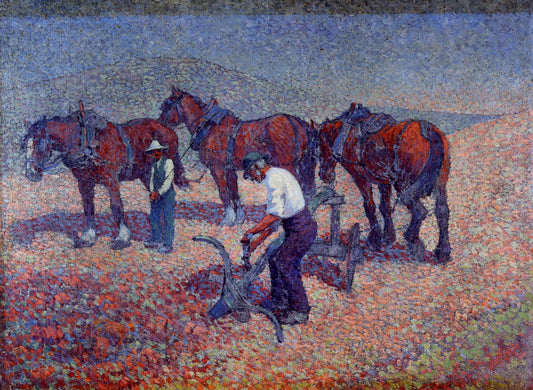
Bevan, Robert Polhill (1865-1925) - Ploughing on the Downs 1907
Vendor:Digital Download - 1 imageRegular price £0.80Regular priceUnit price per -

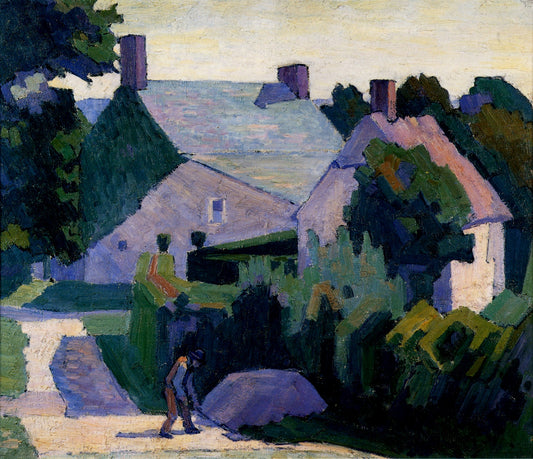
Bevan, Robert Polhill (1865-1925) - Dunn's Cottage 1915
Vendor:Digital Download - 1 imageRegular price £0.80Regular priceUnit price per -

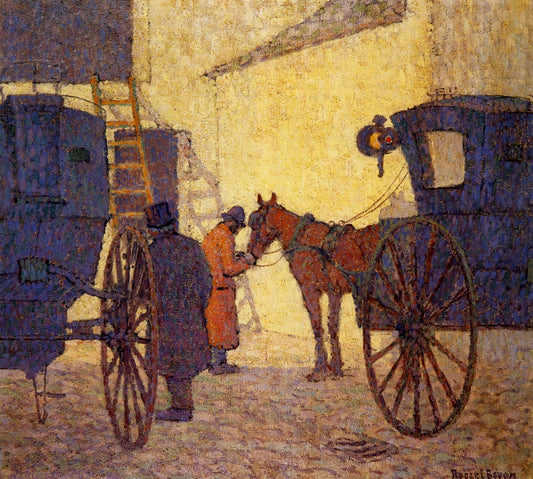
Bevan, Robert Polhill (1865-1925) - Cab Yard at Night c.1910
Vendor:Digital Download - 1 imageRegular price £0.80Regular priceUnit price per -


Bevan, Robert Polhill (1865-1925) - Showing at Tattersalls
Vendor:Digital Download - 1 imageRegular price £0.80Regular priceUnit price per


Latest Picture Trove Blog Posts
View all-

William Morris’s Strawberry Thief: The Story Behind a Classic Arts and Crafts Pattern
Few William Morris designs are as instantly recognisable as Strawberry Thief. With its richly patterned foliage, small red strawberries and watchful birds hidden among curling leaves, it has become one of the most loved designs of the Arts and Crafts movement.
William Morris’s Strawberry Thief: The Story Behind a Classic Arts and Crafts Pattern
Few William Morris designs are as instantly recognisable as Strawberry Thief. With its richly patterned foliage, small red strawberries and watchful birds hidden among curling leaves, it has become one of the most loved designs of the Arts and Crafts movement.
-

Glasgow and the Mackintosh Style
We recently took ourselves off to Scotland, and on our travels, we popped into the Mackintosh Tea Rooms in Glasgow for a bit of a nose around and a spot of lunch.
Glasgow and the Mackintosh Style
We recently took ourselves off to Scotland, and on our travels, we popped into the Mackintosh Tea Rooms in Glasgow for a bit of a nose around and a spot of lunch.
-

A Trip to Edinburgh & Glasgow, and Scottish Art
We have just returned from a well-deserved few days' break in Scotland, visiting both Edinburgh and Glasgow, taking in Scottish art and tea rooms!
A Trip to Edinburgh & Glasgow, and Scottish Art
We have just returned from a well-deserved few days' break in Scotland, visiting both Edinburgh and Glasgow, taking in Scottish art and tea rooms!


