

Michelino Molinari da Besozzo (c.1370-1455) was a notable fifteenth century Italian painter and illuminator, who was widely praised for his work. He worked mostly in Milan and Lombardy, and was employed by the Visconti family, rulers of Milan. Michelino's work follows the traditions of the Lombard School, and maintains the Trecento style.
Michelino was born in c.1370 and died sometime after 1450. It is believed that he is referred to in some documents from the period by the name Michele da Pavia, as he lived in Pavia at the beginning of his career, where he left some frescoes inside the Visconti Castle. Michelino lived in Milan from 1439 until his death, where he worked for the Viscontis, rulers of Milan. When his patron, first Duke of Milan Gian Galeazzo Visconti died and Giovanni Maria Visconti fell into power, Michelino moved to Venice and Vicenza to avoid Giovanni's difficult reign. In Venice, Michelino was in contact with painter Gentile da Fabriano (Gentile di Niccolò di Massio).
Michelino had a son, Leonardo, who was also a manuscript illuminator and worked between 1428 and 1488. Leonardo’s work includes notable frescoes that remain in the church of Saint Giovanni a Carbonara in Naples, Italy.
As a fifteenth-century Italian artist of the Lombard School, Michelino’s illuminations follow a linear form of the International Gothic Style, and are abstract, yet appear to be naturalistic because of the detailed nature of the artist’s work. Though few of his works have survived to the present day, Michelino was among the most famous artists of his day and was widely acclaimed and praised. Remaining examples of Michelino’s work deny the classicising style of the Renaissance, instead maintaining the more rigid forms of the outdated, Gothic style of the Proto-Renaissance. Michelino's career was most relevant during his time in Milan, where he worked for the Visconti family. Michelino was given major commissions in Milan and was notably employed to design windows for the Visconti’s cathedral.
In 1404, Michelino created miniature illuminations for the funeral oration of his patron, Gian Galeazzo Visconti. These miniatures are now owned by the Bibliothèque Nationale in Paris. The text of this Eulogy for Giangaleazzo Visconti was commissioned by the Visconti court and written by an Augustinian friar, Pietro da Castelletto. Michelino's illuminations of the text include delicate garlands of flowers that surround Pietro da Castelletto's text.
Michelino's 1410 visit to Venice was incredibly significant to the overall development of Venetian painting in the following two decades. Both Venice and Vicenza appreciated and lauded Michelino's delicate style. Other notable works include Mystic Marriage of St Catherine, which is now located in the Pinacoteca in Siena. This small painting depicts the marriage between St Catherine and Christ. Mystic Marriage of St Catherine and the Marriage of the Virgin are the only two works (both panel paintings) that can definitively be attributed to Michelino. Marriage of the Virgin is owned by the Metropolitan Museum of Art in New York City, and now has a damaged surface. This work, made from tempera on wood with raised gold ornament depicts an elderly Joseph presenting a young and timid Virgin with a ring. The humour found in the expressions of the surrounding rejected men highlight Michelino's skill through his ability to inject movement into the scene with expression. Marriage of the Virgin mirrors the crowded composition of Michelino's work with illuminated manuscripts; furthermore, the curvilinear forms in the work are emblematic of the International Gothic Style.
Michelino was given great recognition for his work and skill during his lifetime and after, and is only largely unknown today because so few of his works have survived. Humanist Umberto Decembrio called Michelino “the most distinguished artist of our time.” Contemporaries referred to Michelino as the "supreme painter." Furthermore, The Duke of Berry sent an agent to interview Michelino, who reported that Michelino was “the most excellent painter among all the painters in the world.”
Images to download
-

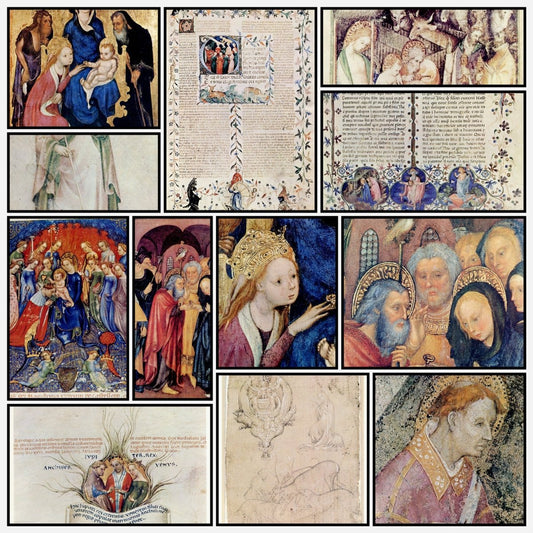
Michelino da Besozzo 12 High Resolution Images
Vendor:Digital Download - 12 imagesRegular price £2.00Regular priceUnit price per -

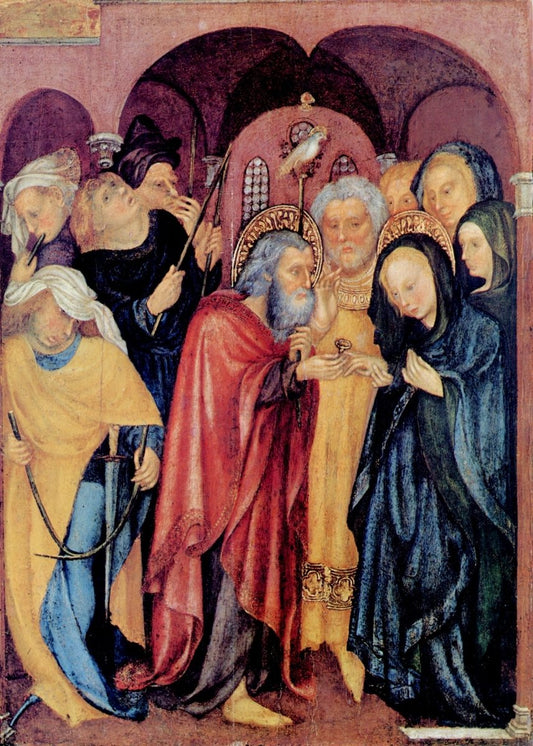
Besozzo, Michelino da (1370-1455) - Marriage of the Virgin c.1430
Vendor:Digital Download - 1 imageRegular price £0.80Regular priceUnit price per -

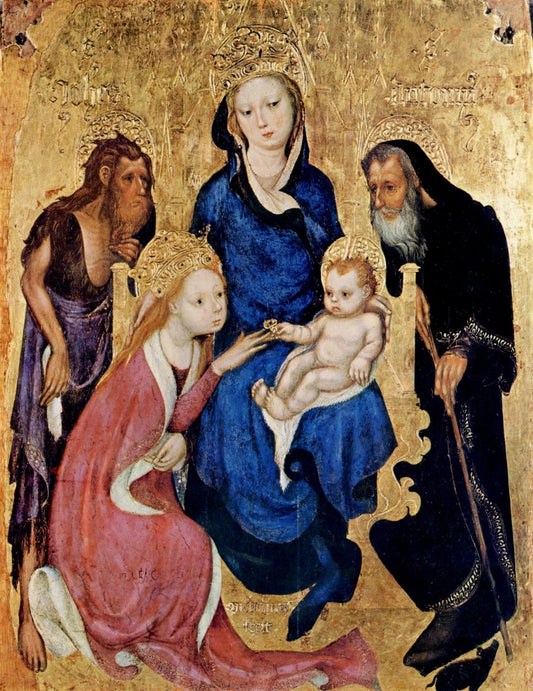
Besozzo, Michelino da (1370-1455) - Marriage of St Catherine c.1420
Vendor:Digital Download - 1 imageRegular price £0.80Regular priceUnit price per


Latest Picture Trove Blog Posts
View all-

William Morris’s Strawberry Thief: The Story Behind a Classic Arts and Crafts Pattern
Few William Morris designs are as instantly recognisable as Strawberry Thief. With its richly patterned foliage, small red strawberries and watchful birds hidden among curling leaves, it has become one of the most loved designs of the Arts and Crafts movement.
William Morris’s Strawberry Thief: The Story Behind a Classic Arts and Crafts Pattern
Few William Morris designs are as instantly recognisable as Strawberry Thief. With its richly patterned foliage, small red strawberries and watchful birds hidden among curling leaves, it has become one of the most loved designs of the Arts and Crafts movement.
-

Glasgow and the Mackintosh Style
We recently took ourselves off to Scotland, and on our travels, we popped into the Mackintosh Tea Rooms in Glasgow for a bit of a nose around and a spot of lunch.
Glasgow and the Mackintosh Style
We recently took ourselves off to Scotland, and on our travels, we popped into the Mackintosh Tea Rooms in Glasgow for a bit of a nose around and a spot of lunch.
-

A Trip to Edinburgh & Glasgow, and Scottish Art
We have just returned from a well-deserved few days' break in Scotland, visiting both Edinburgh and Glasgow, taking in Scottish art and tea rooms!
A Trip to Edinburgh & Glasgow, and Scottish Art
We have just returned from a well-deserved few days' break in Scotland, visiting both Edinburgh and Glasgow, taking in Scottish art and tea rooms!


