

Ferdinand Lucas Bauer (1760-1826) was an Austrian botanical illustrator who travelled on Matthew Flinders' expedition to Australia.
Bauer was born in Feldsberg in 1760, the youngest son of Lucas Bauer, court painter to the Prince of Liechtenstein, but was left fatherless in his first year of life. The eldest son was the successor to their father's position. Together with two of his brothers, Joseph Anton and Franz Andreas, he was placed in the custody of Norbert Boccius (1729-1806), a physician and botanist who was Prior of the monastery at Feldsberg. Under the guidance of Boccius, Bauer became an astute observer of nature and was just 15 when he began to contribute miniature drawings to Boccius' collection. In 1780, Franz and Ferdinand were sent to Vienna to work under the direction of Nikolaus von Jacquin, an eminent botanist and Director of the Royal Botanical Garden at Schönbrunn Palace. There, Bauer was introduced to the Linnean taxonomic system, the field of microscopy, and took lessons in landscape painting.
In mid-1786, on the recommendation of Jacquin, Bauer accompanied the Oxford Professor John Sibthorp as an artist on a field trip to Greece and Asia Minor. They returned to England in December 1787 with over 1,500 sketches of plants, animals, birds and landscapes, some of which appeared in Flora Graeca.
Bauer later travelled to Australia with Matthew Flinders as one of six botanical draughtsmen. He worked under the direction of botanist Robert Brown, and in addition to botany, Bauer was to draw zoological subjects. His exacting standard of work earned him the admiration of both Matthew Flinders and Robert Brown. Writing to Banks, Brown reported that Bauer had made 350 plant sketches and 100 of animals.
Bauer, intent on capturing accurately the tone and shading of his specimens, but unable to carry with him the range of colours needed, covered his preliminary sketches with colour numbers. Banks was intrigued by Bauer's precision, and in January 1806 wrote that they "were prepared in such a manner by reference to a table of colours as to enable him to finish them at his leisure with perfect accuracy".
In June 1803, while Flinders returned to England in order to obtain a replacement for the Investigator, Bauer remained in Australia. He went to Norfolk Island for eight months and also undertook excursions to Newcastle, the Blue Mountains and the south coast of New South Wales. Bauer returned to England on the Investigator, accompanied by 11 cases of drawings containing 1,542 Australian plants, 180 Norfolk Island plants, and over 300 animals.
After Bauer's return to England in 1805, the Admiralty continued to employ Bauer to allow him to publish an account of his travels. Bauer worked on the Illustrationes Florae Novae Hollandiae for five years, doing all the engraving himself. He also contributed ten plates to Flinders' Voyage to Terra Australis.
From 1806 to 1813, 50 sets of Bauer's Illustrationes were published in three parts. Unfortunately, the publishing venture was a failure, and in August 1814 Bauer returned to Vienna, but continued to do much work for English publications, including Lambert's Pinus and Lindley's Digitalis. He acquired a small house in Hietzing near the Schönbrunn Botanical Garden and spent his time painting and making excursions into the Austrian Alps until shortly before his death from dropsy on 17 March 1826.
The bulk of Bauer's finished paintings was acquired by the British Admiralty. In 1843 they were transferred to the British Museum together with additional paintings that Robert Brown had bought from Franz Bauer. Most of the sketches, as well as the herbarium and a collection of skins, were acquired by the Austrian Imperial Museum and are now housed in the Natural History Museum in Vienna.
Whereas Bauer's brother, Franz, is remembered both by a portrait and a memorial in Kew, Ferdinand Bauer himself has no portrait or stone to commemorate him other than a mention in Franz's epitaph in St Anne's Chapel in Kew.
Images to download
-

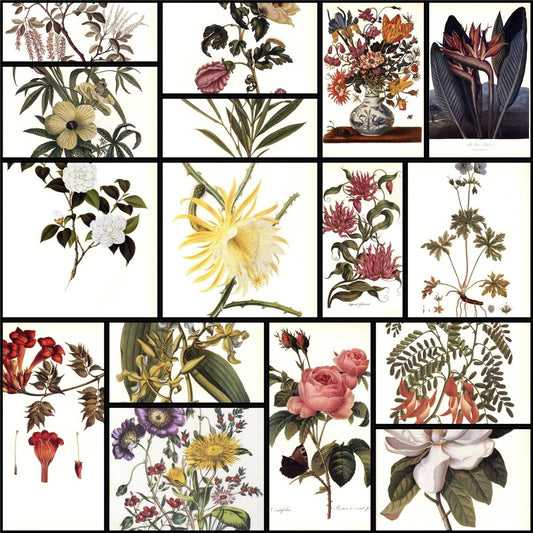
Botanical Prints - 40 High Resolution Images
Vendor:Digital Download - 40 imagesRegular price £4.00Regular priceUnit price per -


Bauer, Ferdinand (1760-1826) - Alyogyne hakeifolia (Red-centred Hibiscus)
Vendor:Digital Download - 1 imageRegular price £0.80Regular priceUnit price per -


Bauer, Ferdinand (1760-1826) - Abelmoschus moschatus (Creeping Hibiscus)
Vendor:Digital Download - 1 imageRegular price £0.80Regular priceUnit price per


Latest Picture Trove Blog Posts
View all-

William Morris’s Strawberry Thief: The Story Behind a Classic Arts and Crafts Pattern
Few William Morris designs are as instantly recognisable as Strawberry Thief. With its richly patterned foliage, small red strawberries and watchful birds hidden among curling leaves, it has become one of the most loved designs of the Arts and Crafts movement.
William Morris’s Strawberry Thief: The Story Behind a Classic Arts and Crafts Pattern
Few William Morris designs are as instantly recognisable as Strawberry Thief. With its richly patterned foliage, small red strawberries and watchful birds hidden among curling leaves, it has become one of the most loved designs of the Arts and Crafts movement.
-

Glasgow and the Mackintosh Style
We recently took ourselves off to Scotland, and on our travels, we popped into the Mackintosh Tea Rooms in Glasgow for a bit of a nose around and a spot of lunch.
Glasgow and the Mackintosh Style
We recently took ourselves off to Scotland, and on our travels, we popped into the Mackintosh Tea Rooms in Glasgow for a bit of a nose around and a spot of lunch.
-

A Trip to Edinburgh & Glasgow, and Scottish Art
We have just returned from a well-deserved few days' break in Scotland, visiting both Edinburgh and Glasgow, taking in Scottish art and tea rooms!
A Trip to Edinburgh & Glasgow, and Scottish Art
We have just returned from a well-deserved few days' break in Scotland, visiting both Edinburgh and Glasgow, taking in Scottish art and tea rooms!


