

Francis Barlow (c.1626-1704) was an English painter, etcher, and illustrator. He ranks among the most prolific book-illustrators and printmakers of the 17th century, working across several genres: natural history, hunting and recreation, politics, and decoration and design.
Barlow is known as "the father of British sporting painting"; he was Britain's first wildlife painter, beginning a tradition that reached a high-point a century later, in the work of George Stubbs. He was furthermore a pioneer in the history of comics by creating A True Narrative of the Horrid Hellish Popish Plot (c.1682), a picture story about the life of Titus Oates and the Popish Plot, which is told in a series of illustrated sequences where the story is written underneath them and the characters depicted on those images use speech balloons to talk. While it is not the first example of its kind in history, it is one of the oldest which is signed.
Barlow was born c.1626 in Lincolnshire. The exact day of Barlow's death is unknown but he was buried on 11 August 1704. Joseph Strutt records that Barlow died in poverty: "not withstanding all his excellency in design, the multitude of pictures and drawings he appears to have made, and the assistance also of a considerable sum of money, said to have been left to him by a friend, he died in indigent circumstances."
Barlow's first major work was the illustration (via twelve plates) of poet Edward Benlowe's Theophila (1652). In Barlow's favour, Bullen said in 1885 that "the volume [was] valued rather for the engravings than for the text." According to Manchester's Chetham's Library, no two copies of Benlowe's Theophila are the same, and no copy survives in good condition. The Victoria and Albert Museum holds two different copies, one of which includes an original drawing by Barlow.
Barlow designed the one hundred and ten woodcuts for John Ogilby's translation of Aesop's Fables, published in 1665, several of the plates of which Barlow etched himself.
Hugh James Rose observed in the early 19th century that Barlow's "chief merit [. . .] as a designer, lay in his exactness in the portrayal of birds, fishes, and animals of all kinds, which are executed in a spirited, and in many instances a masterly manner." One example of this gift is in a set of twelve prints by Wenceslaus Hollar of engravings after drawings by Barlow, entitled Several Ways of Hunting, Hawking, and Fishing, invented by Francis Barlow, engraved by W. Hollar, 1671, published by John Overton.
In the years leading up to the Glorious Revolution, Barlow became the prime designer of political satire in support of the Whigs; Whig MP Denzil Onslow (1642-1721) acquired or commissioned a number of paintings by Barlow, to decorate his manor house, Pyrford Court. These were more recently housed at Clandon Park, an 18th-century mansion near Guildford, Surrey, becoming one of the largest collections of Barlow's surviving work.
Barlow has come to be regarded as a "surprisingly neglected artist". Art historian Mark Hallett accounts for this by noting that Barlow's time is British art's "forgotten era" - one that "has tended to be overshadowed by the achievements of earlier artists, such as Van Dyck, or those that came later, such as Hogarth.
Images to download
-

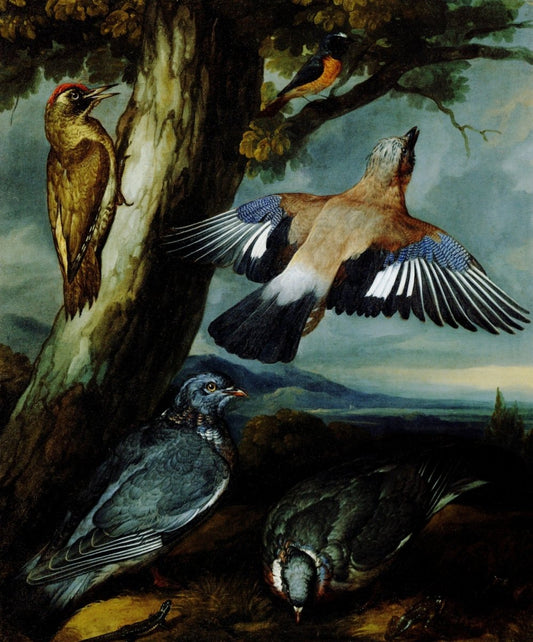
Barlow, Francis (c.1626-1704) - Landscape with a Woodpecker c.1650
Vendor:Digital Download - 1 imageRegular price £0.80Regular priceUnit price per

Latest Picture Trove Blog Posts
View all-

William Morris’s Strawberry Thief: The Story Behind a Classic Arts and Crafts Pattern
Few William Morris designs are as instantly recognisable as Strawberry Thief. With its richly patterned foliage, small red strawberries and watchful birds hidden among curling leaves, it has become one of the most loved designs of the Arts and Crafts movement.
William Morris’s Strawberry Thief: The Story Behind a Classic Arts and Crafts Pattern
Few William Morris designs are as instantly recognisable as Strawberry Thief. With its richly patterned foliage, small red strawberries and watchful birds hidden among curling leaves, it has become one of the most loved designs of the Arts and Crafts movement.
-

Glasgow and the Mackintosh Style
We recently took ourselves off to Scotland, and on our travels, we popped into the Mackintosh Tea Rooms in Glasgow for a bit of a nose around and a spot of lunch.
Glasgow and the Mackintosh Style
We recently took ourselves off to Scotland, and on our travels, we popped into the Mackintosh Tea Rooms in Glasgow for a bit of a nose around and a spot of lunch.
-

A Trip to Edinburgh & Glasgow, and Scottish Art
We have just returned from a well-deserved few days' break in Scotland, visiting both Edinburgh and Glasgow, taking in Scottish art and tea rooms!
A Trip to Edinburgh & Glasgow, and Scottish Art
We have just returned from a well-deserved few days' break in Scotland, visiting both Edinburgh and Glasgow, taking in Scottish art and tea rooms!


