

William Edwin Atkinson (1862-1926), also known as W.E. Atkinson, was a Canadian painter of landscapes and a founding member of the Canadian Art Club in 1907, whose work was influenced by Impressionism combined with aesthetics drawn from the Barbizon school and the Hague School. "He delights in quiet communion with peaceful pastoral scenes", wrote E.F.B. Johnston in 1912.
Atkinson, born in England, moved with his family to Oshawa, Ontario as a child because his father opened an English Drug Store in the town. He attended the University of Toronto, studying chemistry, and worked as a pharmacist before he made the decision to be an artist. He trained at Ontario School of Art in 1881 where he studied with Robert Harris (painter), then in 1883-1884, attended the Pennsylvania Academy, studying with Thomas Eakins. While in Philadelphia, he roomed with George Agnew Reid.
In 1889, he travelled to Paris, France, to study at the Académie Julian and took private lessons with several teachers, of whom the most important was Paul-Louis Delance. That summer, he painted in Pont-Aven in Brittany, an art colony that favoured North American students. From Pont-Aven, Atkinson wrote letters home, describing his experiences which were published in his hometown newspaper, The Vindicator.
Paul Gauguin was in Pont-Aven that summer and one day when Atkinson was painting an old mill, Gauguin, passing by, told him to use stronger colour, saying that (Atkinson recalled later), "If the sky is blue, paint the roof red. If the roof is blue, paint the sky green." (Atkinson's account of the meeting is recounted in the Toronto Star of 1926.)
It is clear that Atkinson followed the broad outline of Gauguin`s advice and strengthened his colour. The American artist Robert Henri, in Pont-Aven in September that year, noted that Atkinson had keyed his colour up to the highest pitch.
After Paris, Atkinson worked for some time in Devon, England and in Holland before returning to Canada. He settled in Toronto. His paintings in Canada reveal that he never forgot what he had learned abroad: the low tones and subject-matter of the Barbizon school and the Hague school as well as the loose brushwork of a modified form of Impressionism. The light in his work might be hazy, but the forms are luminous and his use of colour, though muted, is brighter than that of his predecessors.
For the period, his work was considered progressive, and as a result, he was made an associate member of the Royal Canadian Academy of Arts and, in 1907, was invited to be one of the founders of the Canadian Art Club in Toronto.
Images to download
-

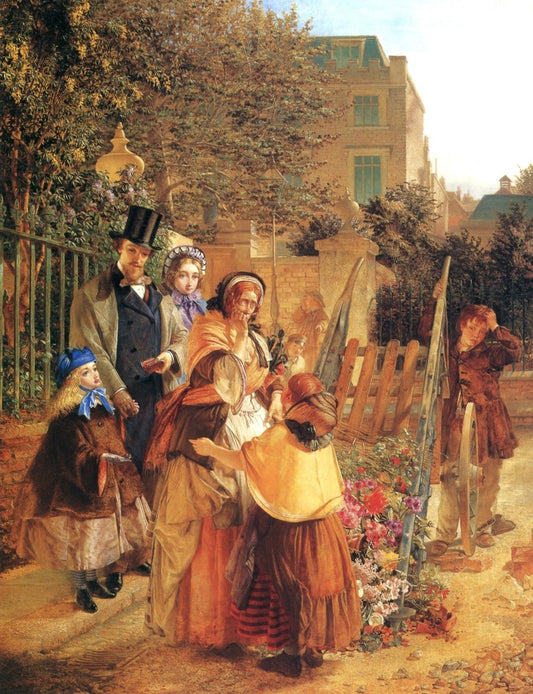
Atkinson, William Edwin (1862-1926) - The Upset Flower Cart c.1862
Vendor:Digital Download - 1 imageRegular price £0.80Regular priceUnit price per

Latest Picture Trove Blog Posts
View all-

William Morris’s Strawberry Thief: The Story Behind a Classic Arts and Crafts Pattern
Few William Morris designs are as instantly recognisable as Strawberry Thief. With its richly patterned foliage, small red strawberries and watchful birds hidden among curling leaves, it has become one of the most loved designs of the Arts and Crafts movement.
William Morris’s Strawberry Thief: The Story Behind a Classic Arts and Crafts Pattern
Few William Morris designs are as instantly recognisable as Strawberry Thief. With its richly patterned foliage, small red strawberries and watchful birds hidden among curling leaves, it has become one of the most loved designs of the Arts and Crafts movement.
-

Glasgow and the Mackintosh Style
We recently took ourselves off to Scotland, and on our travels, we popped into the Mackintosh Tea Rooms in Glasgow for a bit of a nose around and a spot of lunch.
Glasgow and the Mackintosh Style
We recently took ourselves off to Scotland, and on our travels, we popped into the Mackintosh Tea Rooms in Glasgow for a bit of a nose around and a spot of lunch.
-

A Trip to Edinburgh & Glasgow, and Scottish Art
We have just returned from a well-deserved few days' break in Scotland, visiting both Edinburgh and Glasgow, taking in Scottish art and tea rooms!
A Trip to Edinburgh & Glasgow, and Scottish Art
We have just returned from a well-deserved few days' break in Scotland, visiting both Edinburgh and Glasgow, taking in Scottish art and tea rooms!


