
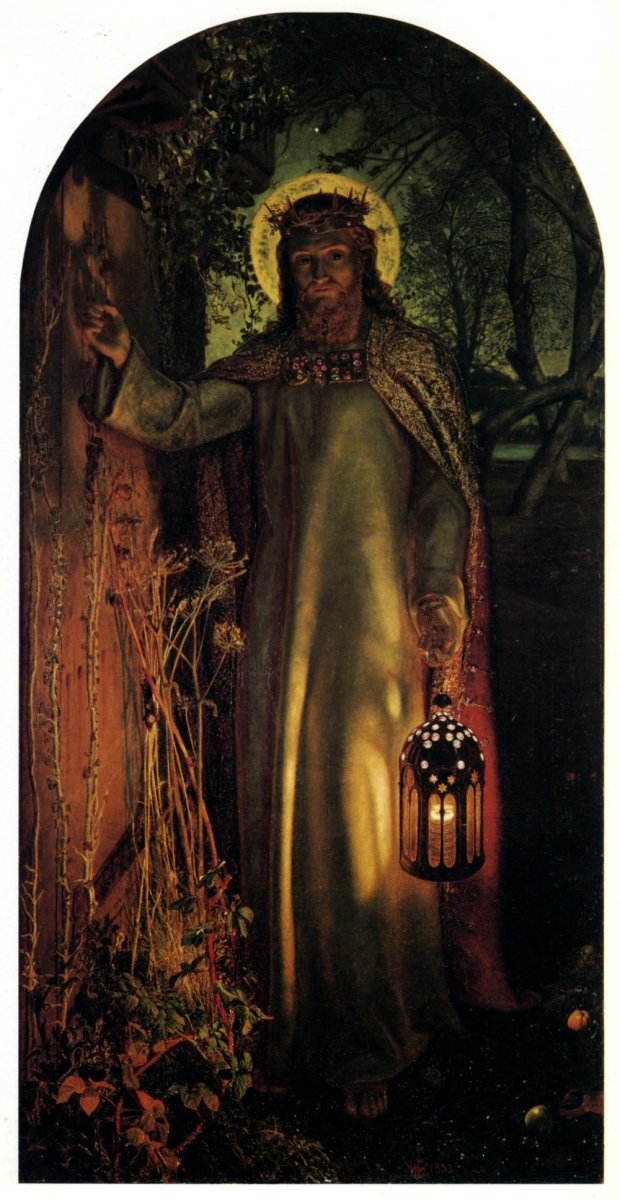
William Holman Hunt (1827-1910) was an English painter and one of the founders of the Pre-Raphaelite Brotherhood. His paintings were notable for their great attention to detail, vivid colour and elaborate symbolism. These features were influenced by the writings of John Ruskin and Thomas Carlyle, according to whom the world itself should be read as a system of visual signs. For Hunt it was the duty of the artist to reveal the correspondence between sign and fact. Of all the members of the Pre-Raphaelite Brotherhood, Hunt remained most true to their ideals throughout his career.
Born at Cheapside, City of London, as William Hobman Hunt, to warehouse manager William Hunt (1800-1856) and Sarah (c.1798-1884), daughter of William Hobman, of Rotherhithe Hunt adopted the name "Holman" instead of "Hobman" when he discovered that a clerk had misspelled the name that way after his baptism at the Anglican church of Saint Mary the Virgin, Ewell. The Hobman family were wealthy, and it was thought that Sarah had made an unequal marriage. After eventually entering the Royal Academy art schools, having initially been rejected, Hunt rebelled against the influence of its founder Sir Joshua Reynolds. He formed the Pre-Raphaelite movement in 1848, after meeting the poet and artist Dante Gabriel Rossetti. Along with John Everett Millais they sought to revitalise art by emphasising the detailed observation of the natural world in a spirit of quasi-religious devotion to truth.
Hunt married twice. After a failed engagement to his model Annie Miller, in 1861 he married Fanny Waugh, who later modelled for the figure of Isabella. She died at the end of 1866 in childbirth in Italy. His second wife, Edith, was Fanny's youngest sister. At the time it was illegal in Great Britain to marry one's deceased wife's sister, so the two of them travelled abroad and married at Neuchâtel, Switzerland in November 1875. This led to a grave conflict with other family members, notably his former Pre-Raphaelite colleague Thomas Woolner, who had once been in love with Fanny and had married the middle sister, Alice Waugh.
Hunt's works were not initially successful, and were widely attacked in the art press for their alleged clumsiness and ugliness. He achieved some early note for his intensely naturalistic scenes of modern rural and urban life, such as The Hireling Shepherd and The Awakening Conscience. However, it was for his religious paintings that he became famous, initially The Light of the World (1851-1853), now in the chapel at Keble College, Oxford, England; a later version (1900) toured the world and now has its home in St Paul's Cathedral, London. Hunt worked at his home in Prospect Place (now Cheyne Walk), Chelsea, London.
He eventually had to abandon painting because failing eyesight meant that he could not achieve the quality that he wanted. His last major works, including a large version of The Light of the World hanging in St Paul's Cathedral, London, were completed with the help of his assistant, Edward Robert Hughes.
Images to download
-
William Holman Hunt 17 High Resolution Images
Vendor:Digital Download - 17 imagesRegular price £3.00Regular priceUnit price per -
Pre-Raphaelite Collection - 574 Images
Vendor:Digital Download - 574 imagesRegular price £10.00Regular priceUnit price per


Latest Picture Trove Blog Posts
View all-

Radical Harmony - Helene Kröller-Müller's Neo-Impressionists
We had the pleasure of visiting the National Gallery in London at the weekend where we saw Radical Harmony; Helene Kröller-Müller's Neo-Impressionists.
Radical Harmony - Helene Kröller-Müller's Neo-Impressionists
We had the pleasure of visiting the National Gallery in London at the weekend where we saw Radical Harmony; Helene Kröller-Müller's Neo-Impressionists.
-

Discovering Warwick Goble and The Book of Fairy Poetry: A Timeless Journey into Enchanted Realms
"The Book of Fairy Poetry", illustrated by Warwick Goble, is more than a century old yet continues enthralling readers of all ages with its spellbinding artwork and verses.
Discovering Warwick Goble and The Book of Fairy Poetry: A Timeless Journey into Enchanted Realms
"The Book of Fairy Poetry", illustrated by Warwick Goble, is more than a century old yet continues enthralling readers of all ages with its spellbinding artwork and verses.
-

William Orpen's 'To the Unknown British Soldier in France'
There is a fascinating story about this picture that not only highlights the pomposity and arrogance of the politicians of the time of World War I but has also introduced me to the word 'vainglory', which I hadn't heard before but which is no doubt appropriate for some of today's leaders.
William Orpen's 'To the Unknown British Soldier in France'
There is a fascinating story about this picture that not only highlights the pomposity and arrogance of the politicians of the time of World War I but has also introduced me to the word 'vainglory', which I hadn't heard before but which is no doubt appropriate for some of today's leaders.


