

Harry Whitter Frees (1879-1953) was born in Reading, Pennsylvania, the younger of two sons born to his father who was a saddler, and his mother who stayed home to care for her two boys.
Frees became an animal photographer solely by accident. When Harry was a teen, the Frees family gathered for a birthday celebration. Someone brought a paper hat to the dining table, and it was put on the head of the family cat. Amazingly, the cat held the pose, and Harry Frees was able to photograph her. After developing this photograph and taking a few similar ones, Frees made his first sale to a postcard publishing company. At the turn of the century, picture postcards were just coming into vogue and publishers welcomed creative ideas, therefore Frees became well-known as an animal photographer.
When Frees first began selling his work to postcard companies, his animal photographs were relatively simple, however later on, the scenarios became more complex and story-like. The Frees’ family cat, Rags, was an exemplary model. In his early photos, Frees used her frequently. Her patience for the job was beyond that of a typical cat.
Because Frees’ work with the animals was unique, he was often interviewed by the press. Were the photographs faked in some way or were the animals drugged? These were questions Frees frequently faced. Frees consistently assured reporters that no extraordinary or inhumane means were used with the animals, and that patience was the main ingredient for getting these pictures taken. Rags was eventually joined by Fluffy, a beautiful Angora cat who also exhibited patience.
After ten years of selling his work to postcard companies, he also began making sales to magazines, including 'Child Life' and 'Woman’s World'. These photos appeared next to animal stories written by Frees. The context of the stories dictated more elaborate scenarios for the animals.
Starting in 1915 Lothrop, Lee and Shepard began bringing out books featuring stories and photos. His first book was 'The Little Folks of Animal Land' (1915). His most successful was 'Animal Mother Goose, with Characters Photographed from Life' (1921).
Frees was attentive to his parents for as long as they lived. When they finally passed away in the 1940s, he moved to Clearwater, Florida. According to Anne R. Bradford who collected Frees’ postcards and attempted to document his story, Frees kept to himself in Florida and remained isolated. When Frees was diagnosed with cancer in 1953, he took his own life.
Images to download
-

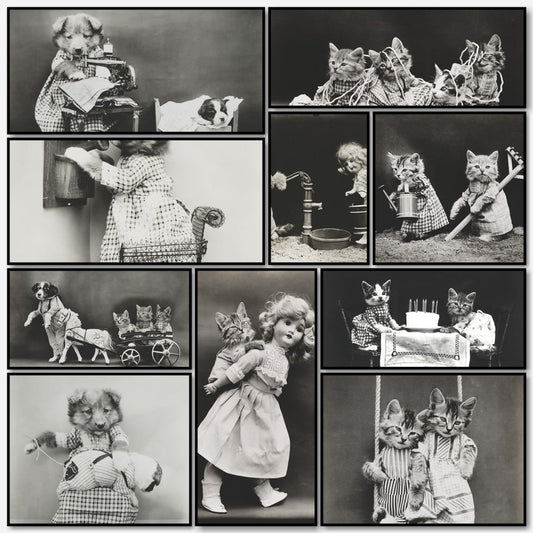
Harry Frees' Cat Photographs - Harry Whittier Frees (1879-1953) - 30 images
Vendor:Digital Download - 30 imagesRegular price £2.00Regular priceUnit price per

Latest Picture Trove Blog Posts
View all-

William Morris’s Strawberry Thief: The Story Behind a Classic Arts and Crafts Pattern
Few William Morris designs are as instantly recognisable as Strawberry Thief. With its richly patterned foliage, small red strawberries and watchful birds hidden among curling leaves, it has become one of the most loved designs of the Arts and Crafts movement.
William Morris’s Strawberry Thief: The Story Behind a Classic Arts and Crafts Pattern
Few William Morris designs are as instantly recognisable as Strawberry Thief. With its richly patterned foliage, small red strawberries and watchful birds hidden among curling leaves, it has become one of the most loved designs of the Arts and Crafts movement.
-

Glasgow and the Mackintosh Style
We recently took ourselves off to Scotland, and on our travels, we popped into the Mackintosh Tea Rooms in Glasgow for a bit of a nose around and a spot of lunch.
Glasgow and the Mackintosh Style
We recently took ourselves off to Scotland, and on our travels, we popped into the Mackintosh Tea Rooms in Glasgow for a bit of a nose around and a spot of lunch.
-

A Trip to Edinburgh & Glasgow, and Scottish Art
We have just returned from a well-deserved few days' break in Scotland, visiting both Edinburgh and Glasgow, taking in Scottish art and tea rooms!
A Trip to Edinburgh & Glasgow, and Scottish Art
We have just returned from a well-deserved few days' break in Scotland, visiting both Edinburgh and Glasgow, taking in Scottish art and tea rooms!


